Tiered link building is one of the most effective ways to build links, both because it looks natural and because it can boost the rankings of your best pages and your website in general.
If you’ve never given tiered link building a try, in this post we’ll show you how to use it to boost your off-page SEO results like a pro.
What is tiered link building?
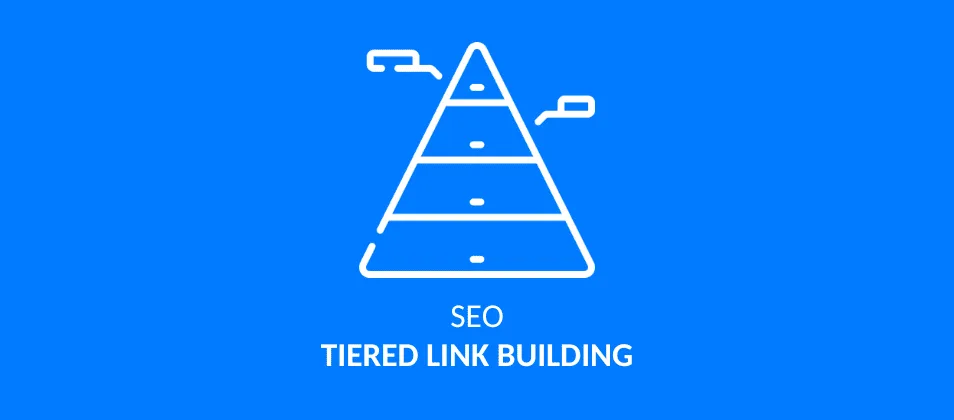
Tiered link building, also known as level-based link building or link pyramid, is a link building strategy in which you generate backlinks to your website by assigning them different objectives depending on their level (which varies according to characteristics such as the quality of the website, its authority, and relevance).
So instead of just generating SEO links and pointing them to your website, you organize them strategically to drive a specific part of your link building strategy.
There are three levels in tiered link building:
- Level 1 or tier 1 is for the highest quality and strongest links, which will point directly to your website. You can obtain these links on websites that are highly relevant in terms of subject matter, have a lot of authority, and are well positioned.
- Level 2 or tier 2 is for links of intermediate quality, which are those that will point to the pages from which you link to your website (level 1). Here, it may be more generalist websites that give you backlinks, forums, even social networks, newspapers, etc.
- Level 3 or tier 3 is for lower quality links, which are links that will only direct to the pages where the level 2 links come from. As such, they are backlinks where the goal is quantity rather than quality. You only want to boost the pages where the level 2 links are located.
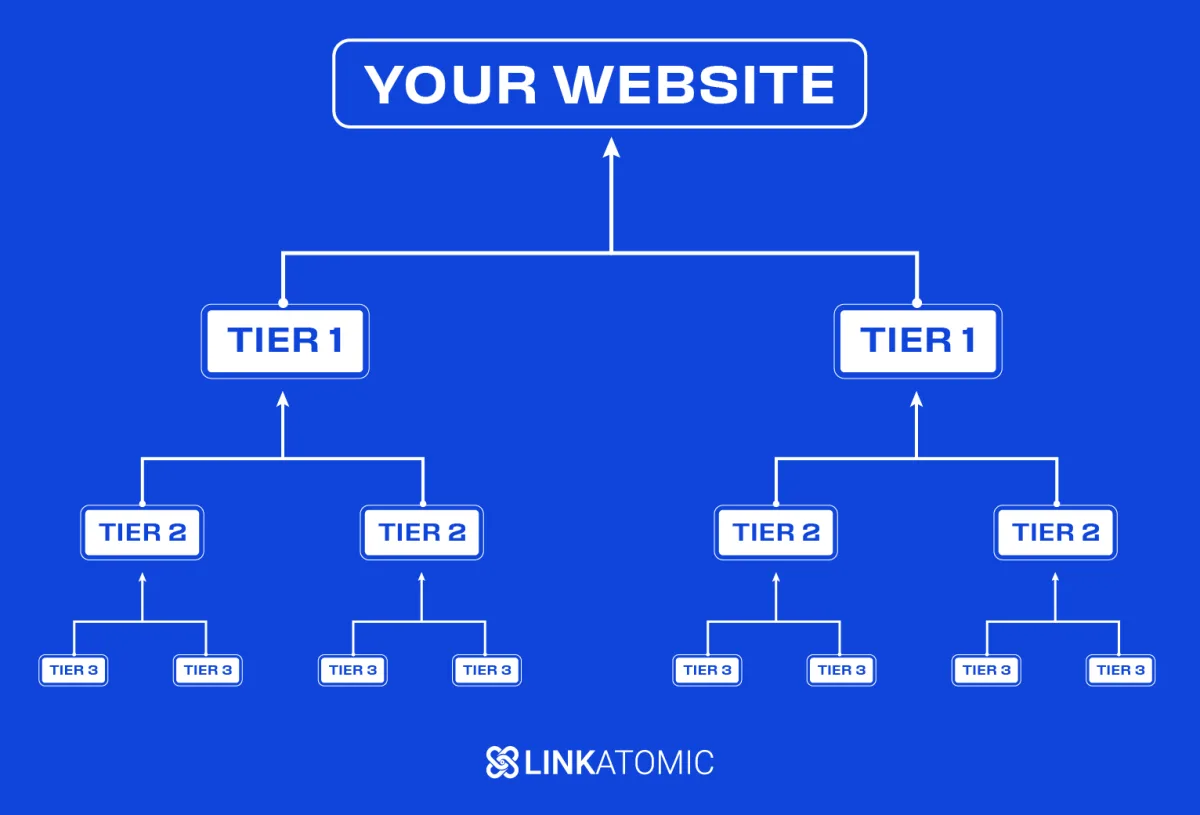
As you can see, link levels are organized like a pyramid: at the base are the most numerous, lower-quality links, and at the top are the most important and relevant ones, driven by all the previous ones and linking to your website to significantly boost its authority and SEO positioning.
What advantages does tiered link building offer you?
- It allows you to create a more natural link profile: the naturalness of your link profile is what will make Google value it and truly improve your rankings as a result. With tiered link building, you take care of naturalness to the maximum.
- You can generate a lot of authority if you do it right: so many well-organized links will generate a lot of authority (especially if you choose tier 1 and 2 links correctly). That authority will be channeled to your website, strengthening it significantly.
- Exponentially increase your visibility: with tiered link building, you get more than just SEO links; ultimately, you are also amplifying your online presence on all the websites that link to and mention you, which is no small feat.
- It can influence your visibility with AI: every mention and link your website receives can increase your chances of appearing in AI responses, which is why tiered link building can also be considered one of the best link building strategies for positioning in AI.
Does tiered link building still work?
Like almost everything else related to link building, some things may change over time, but tiered link building still works. As long as Google continues to place so much value on the backlinks and mentions a website receives, this strategy will continue to make sense.
However, for the strategy to be effective and safe, you must apply it with more discretion and maintain as much naturalness as possible.
Expert advice
Be mindful of the pace at which you generate your backlinks (keep it steady, without sudden spikes). This will prevent Google from viewing your link building strategy as unusual.
Also, ensure that your links meet minimum quality standards, especially at levels 2 and 3. Not everything is acceptable, even for the lowest tiers of the strategy.

Laura García
SEO and Link Building Campaign ManagerTips for getting the most out of tiered link building
- Pay attention to what your competition is doing: for a good tiered link building strategy, you will need a lot of information. Although you can research from scratch, it is usually a good idea to review what your competition is doing and look for good backlinks from there. To do this, you can use some of the best competitor analysis tools or Linkatomic’s internal functionality to detect your competitors’ backlinks.
- Stay on track with your strategy: it’s easy to fall into the temptation of pointing a bunch of tier 3 or tier 2 backlinks directly to your website, but it’s crucial that you stay on track with your strategy. This is what guarantees results and also protects you from Google penalties (which you’ll want to avoid at all costs).
- Be mindful of the relevance of each backlink: just because your tiered link building strategy includes low-quality links (tier 3, for example) doesn’t mean you can completely forget about relevance. In general, it’s always a good idea for your backlinks (whether tier 1, 2, or 3) to come from websites that are related to yours in terms of subject matter or the keywords they rank for.
- Don’t over-optimize anchor texts: although anchor texts are very powerful in link building to boost your positioning and authority, it is advisable not to always use the same one. Vary between partial match anchor texts, brand keywords, and generic phrases. This will ensure that backlinks look natural.
In SEO, strategies come and go as Google evolves, and what works also changes. However, link building remains one of the most powerful ways to rank (and perhaps the most effective). That’s why strategies such as tiered link building still work.
In fact, today they can actually give you better results considering how much you can influence AI responses with sufficient visibility and authority.
¿Te ha gustado el artículo?
[Votos: 1 Nota: 5]